 Glover Law Firm Home
Legal Advocacy
Contact Us Now For a Free Consultation






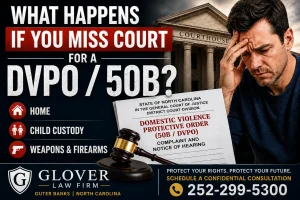 A North Carolina Domestic Violence Protective Order, commonly called a DVPO or 50B order, is a civil court order that can affect where you live, contact with another party, temporary custody of children, possession of property, and firearms. If you have been served with a 50B complaint and hearing notice, missing court does not make the case disappear and may leave the judge deciding important issues without hearing your side.
| 50B / DVPO Issue | What North Carolina Law Provides |
|---|---|
Type of case | A Domestic Violence Protective Order proceeding under Chapter 50B is a civil action. It may arise from the same events as criminal domestic violence charges, but the proceedings are legally separate. |
Missing the hearing | A defendant may choose not to appear, but the Court (the Judge) may proceed without the defendant. The plaintiff must still present evidence sufficient for the Court to grant the requested protective relief. |
Ex parte order | A Court may enter temporary emergency relief before the defendant has been heard. After an ex parte order is issued, North Carolina law provides for a prompt hearing under the timetable established by N.C.G.S. § 50B-2. |
What the Court may order | A DVPO may address contact between the parties, possession of a residence, temporary custody and visitation, child or spousal support where authorized, possession of personal property, pets, and other protective conditions authorized by Chapter 50B. |
Consent Order | The parties may agree in writing to a consent protective order or "Consent Order" without findings of fact and conclusions of law. The consent order remains valid and enforceable. |
Firearms | Firearm, ammunition, and permit surrender may be required when the statutory conditions in N.C.G.S. § 50B-3.1 are present. Additional state or federal firearm restrictions often also apply, depending on the order. |
How long an order may last | A Chapter 50B protective order may initially remain in effect for a fixed period of up to one year. A Court may renew an order for a fixed period of up to two years upon the required motion and showing. |
Violating the order | Knowingly violating a valid protective order is generally a Class A1 misdemeanor under N.C.G.S. § 50B-4.1. North Carolina law provides more serious consequences in certain circumstances. |
If you have been served with a North Carolina Domestic Violence Protective Order complaint, ex parte order, or notice of a 50B hearing, read every part of the paperwork and pay close attention to the hearing date and the restrictions already in place. Do not assume that staying away from court will cause the case to be dismissed or prevent additional terms from being entered. If you have more questions about a civil domestic violence case, check out our Chapter 50B Protective Order FAQS Your Rights and Responsibilities.
Glover Law Firm may be available to help you evaluate the allegations, the requested relief, the effect of an existing ex parte order, and your options before the hearing. Representation can also provide a way to determine whether the matter should be contested, negotiated, or resolved through an appropriately drafted consent order. Call now to schedule a confidential consultation: 252-299-5300
Read Full Video TranscriptDanny Glover:
If a 50B action, or a Domestic Violence Protective Order, has been filed against you, that Domestic Violence Protective Order, or DVPO, which is just sort of a domestic violence restraining order, basically, you have the option of going to court. You do not have to be there. Just like with any lawsuit or civil action, the defendant does not have to appear.
Now, if you don't appear, then the plaintiff, or the person who filed for the restraining order, is basically going to get whatever they want in most cases. That can include vehicles, assets, an order that requires you to give up all the weapons that you may own, temporary custody of children, an order for you to stay away from home, workplace, school, that kind of thing.
And so, you don't have to be there, but it's always a good idea that you hire an attorney to protect you and then show up to the hearing to avoid any overreaching or unlawful order from being entered against you.
Even if you go, that doesn't mean you have to testify, and that doesn't mean there's going to be a hearing. A lot of times, DVPO cases are worked out by some agreement, which can even include an order that does not include any findings.
So, you know, if you have no interest in seeing that person ever again, then it's fairly easy to have an order entered keeping you away from that person without any court finding or any admission by you that you've done anything wrong or committed any acts of domestic violence.
Domestic violence orders also have further-reaching consequences that a lot of people don't understand. If you ever want to own firearms legally, if you want to apply for a carry concealed weapon permit in the future, if you have Domestic Violence Protective Orders entered against you, that could really jeopardize your ability to do that.
So it's always a good idea to have an attorney present with you if you've ever been accused of any type of domestic violence.


 Your Privacy Choices Cookie Policy Manage Cookies
This site is protected by reCAPTCHA.
Please do not include any confidential or sensitive information in a contact form, text message, or voicemail. The contact form sends information by non-encrypted email, which is not secure. Submitting a contact form, sending a text message, making a phone call, or leaving a voicemail does not create an attorney-client relationship.